Spotlighting the interdependence of forests and agriculture through water – a collective and evidence-based effort
Forests and trees are powerful, often undervalued allies of agriculture. A new publication—developed by FAO, SEI, The Nature Conservancy and Conservation International—synthesizes the latest science on how forests and trees regulate climate, water and ecosystem functions that directly underpin agricultural performance. The report draws on extensive research from around the world to demonstrate how forests moderate temperatures, sustain rainfall and regulate the water cycle, directly supporting crop productivity, stabilizing local climates and improving the health, safety and livelihoods of rural communities, while highlighting the consequences of deforestation on the world’s agrifood systems.
Unlocking these benefits requires integrated landscape approaches, cross-sector governance, and policies that recognize forest conservation, restoration and sustainable use as strategic investments in food security, public health and climate resilience. Promoting forest–agriculture synergies offers a pathway toward more productive, sustainable and equitable agrifood systems.
Nine of the report co-authors are members of the Focali research network representing a broad range of disciplines and research environments. The report lead author Focali member Rafaela Flach, Research fellow at SEI, initiated this report and together with the involved partners gathered researchers from around the world in this collective effort to make sense of the diverse and growing evidence on the multiple ways forests and trees sustain agriculture worldwide and its implications for policy and practice.
In this article and a Linked In post to celebrate the entangled international forest and water days seven of the co-authors share their reflections on the important but often undervalued connections between forest, water, food systems and livelihoods.
Rafaela Flach, Research fellow at SEI,
Report’s lead author
The science is clear: forests and trees underpin resilient food systems through water, climate and ecosystem services. Bringing together researchers from around the world, we worked to make sense of the diverse and growing evidence on the multiple ways forests and trees sustain agriculture worldwide. My hope is that this helps turn complexity into more actionable insights for decision-makers.
Aida Bargués Tobella, Researcher, Agrotecnio and Associate Professor, SLU
Co-lead author of chapter 4 “The critical role of forests and trees in regulating the water cycle”
Despite solid evidence, the benefits that forests and trees provide to agriculture remain largely overlooked. Global policy still treats forest and tree-cover protection as competing with agriculture, rather than recognizing how essential trees and forests are for resilient food production. This report brings that evidence forward, going beyond carbon to highlight these crucial contributions.
Selorm Kugbega, Research fellow at SEI
Co-lead author of chapter 5 “Contribution of biodiversity-mediated and other forest ecosystem services to agriculture
The proximity of agricultural systems to natural habitats is a key determinant of ecosystem service flows, as forests and trees provide essential nesting and feeding resources for beneficial species that support pollination, biocontrol, and soil health. Harnessing these co-benefits within food systems represents a practical pathway to address climate change, biodiversity loss, and food security- a call to action grounded in our shared moral responsibility to both nature and humanity.
Malin Lundberg Ingmarsson, Advisor Water, Climate and Environment, SIWI
Co-lead author of chapter 4 “The critical role of forests and trees in regulating the water cycle
Forests in or near agricultural areas are crucial for maintaining soil moisture and reducing soil evaporation, mitigating extreme events like floods or droughts, and supporting steady water flows to neighboring fields and communities – all core to climate-resilient farms across the globe.
Maganizo Kruger Nyasulu, Research Fellow, University of Oxford
Contributing author of chapter 3 “Forest–climate–agriculture interactions at multiple scales”
Disruptions in forest–water systems are not just environmental shocks, they are macroprudential risks: declining water availability constrains key sectors from agriculture to semiconductors and AI data centers, impairing production, cash flows, and asset values; as these stresses propagate, they elevate credit risk, strain insurers, and expose financial institutions and sovereigns to systemic instability, ultimately undermining economic resilience and the functioning of the financial system.
Agnes Pranindita, PhD Graduate / Post-Doc Stockholm Resilience Centre
Contributing author of chapter 3 “Forest–climate–agriculture interactions at multiple scales”
As we increase our efforts to understand the intricate ways in which forests, water, foods, and livelihoods are entangled, it is important to view them as elements in a system. Once we have done so, it is hard to ignore how changes in one of these elements would affect the others, and vice versa. Exploring the synergies between them is crucial for addressing our societal challenges through policies and practice.
Paul Egan, Researcher at SLU and at Agriculture and Forestry University, Nepal
Co-lead author of chapter 5 “Contribution of biodiversity-mediated and other forest ecosystem services to agriculture”
By zooming in on the evidence of where forest conservation and agricultural production goals can be mutually reinforcing, we hope that this report will serve as a catalyst for global policy and development frameworks and practitioners alike.
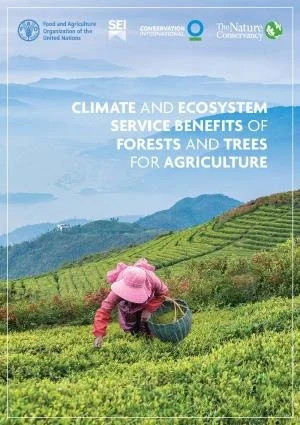
Download the report here Climate and ecosystem service benefits of forests and trees for agriculture (front cover below)
Re-watch the report launch at COP30 here Forest Pavilion at COP30 – 19 Nov – Forests & agriculture synergies
Re-watch related event at the World Water Week involving many of the co-authors The role of forests and trees in future-proofing water and agriculture